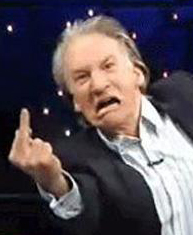
Let’s start with one immutable truth: Bill Maher is a preening jackass. His smarmy on-stage persona combined with his screeds against Muslims and organized religion leave me cold. And if his “Real Time” disappeared from HBO and we never heard from him again, I wouldn’t lose a millisecond of sleep.
But here’s a second immutable truth: If Maher is forced from his show and public view because he uttered the N-word during a conversation with Sen Ben Sasse (R-Neb.) on the June 2 episode of “Real Time,” it would be a mistake.
Don’t get twisted. On general principle, Maher deserves the castigation he’s receiving from all corners. His arrogance in taking a liberty that he wasn’t remotely entitled to was towering, exceeded only by his reportedly prodigious ego.
People have to be able to deliver unpopular thoughts and ideas, to say things that offend and occasionally shock the conventional wisdom. Otherwise, this little experiment in freedom doesn’t work.
To recap, Maher pronounced himself to be a “house” N-word when Sasse jokingly invited him to Nebraska to work in the corn fields. That he could have possibly believed that his remark — even if it was flippant and unintentionally hurtful — would pass without drawing fire is proof that Maher and reality are only coincidentally linked.
This wasn’t the first time Maher waded into these waters. He hosted a debate on the use of potentially inflammatory language in comedy during a 2001 episode of his previous show, “Politically Incorrect.” In the attached clip (at around the 9:00 minute mark), Maher proceeds to lecture African-American actress Anne-Marie Johnson on how use of the N-word had been co-opted, going so far to tell the light-skinned Johnson that he wouldn’t know that she was black unless she told him. How Johnson kept her composure without smacking Maher into the next century is beyond me.
Back in the present, Sen. Al Franken (D-Minn.) has canceled a scheduled June 9 appearance on “Real Time,” while virtually every African-American with a high profile, from Al Sharpton to Chance the Rapper to Kevin Hart has taken a verbal swing at Maher.
HBO, whose black subscriber base is significant, tried to get ahead of the building furor by chastising Maher for being “completely inexcusable and tasteless.” The company excised the N-word from re-airs of the show that airs live the first time.
And Maher, perhaps sensing the end of his gravy train, issued an apology the next day, calling the word “offensive” and expressing “regret” at having used it.
Despite the kerfluffle, HBO has decided to keep Maher at the helm of “Real Time,” for now. Officials at the cable giant will, no doubt, stick their corporate fingers in the wind, to see whether viewership drops off before making the call on pulling the plug.
Maher ought to get another chance, not because he’s necessarily earned it, but because to do otherwise would send a chill through the notion of free speech.
Understand that Maher is not protected by the First Amendment from the consequences of his actions. While the Constitution gives us the freedom to speak against the government without worry of repercussion, i.e. arrest for protesting against the president, the hallowed document does not protect a person from the ramifications of speech from private citizens.
In other words, the police can’t arrest a person for yelling the N-word at a busy street corner. Indeed, they might be inclined to arrest anyone who attacked the speaker. But the law wouldn’t preclude the speaker’s employer for taking action — including firing — for their conduct if the employer reasonably believed that the speaker’s words brought embarrassment on the employer.
That said, the muscle of free speech has to be fully exercised in the American body politic for it to work properly. People have to be able to deliver unpopular thoughts and ideas, to say things that offend and occasionally shock the conventional wisdom. Otherwise, this little experiment in freedom doesn’t work.
As odious as it may sound, people like Bill Maher and Ice Cube, who will appear on “Real Time” Friday, have to be able to say the N-word without fear.
And that brings us to another part of the discussion, namely, who gets to say the N-word.
If we’re all honest, the majority of the outrage over Maher’s utterance has little to do with what was said, but with who said it. Because the N-word has historically been the single most debilitating word aimed at blacks, the idea of a white man — who remains the dominating force in American society — using that word, even in a flippant, joking way, as Maher did, is galling to many.
On top of that, Maher’s invocation of the concept of the “house N-word” only exacerbated the issue. During slavery, there was a delineation between those who worked the fields and those who worked in the master’s home, with the clear implication being that the “house n——” were superior to those who worked outside.
It’s been said among those African-Americans who have defended Maher that his previous exploration of issues affecting the black culture afforded him some level of clearance for last Friday.
In some circles, Maher had earned status as an honorary black person, in the way some proclaimed Bill Clinton the first black president because he “felt their pain.”
From this corner, if Maher had such an honorary membership card, its value was revoked last Friday.
But, in the previously referenced 2001 clip from “Politically Incorrect,” Maher stumbled onto a salient argument at the core of the argument over the N-word.
Maher complained that the use of the N-word has become rampant in black culture.
“Every African-American person in this audience users that word night and day, it’s in every song it’s all through culture,” said Maher.
Maher may have dramatically overstated the case then, but it feels today as though he was prescient.
Few can argue that the n-word is a staple of the worlds of hip-hop and rap. The artists and their fans who use the word employ a two-part argument as their defense/explanation.
First, they claim that when blacks use the word, they are recasting it as a form of endearment, as if they are talking with and about a friend.
The second prong of the argument is that the user is not using the entirely negative -er form of the word, but rather the -a form that is entirely non-threatening.
Frankly, both seem, from this perspective to be distinctions without a difference. In a perfect world, we’d all follow the model of Richard Pryor who declared, in a 1980s concert film, that he would never again use the N-word after it had been a fixture of his stand-up routine.
But that’s not happening anytime soon. In the interim, the N-word remains available to singers, comedians and preening jackasses alike.
 sports@large blog