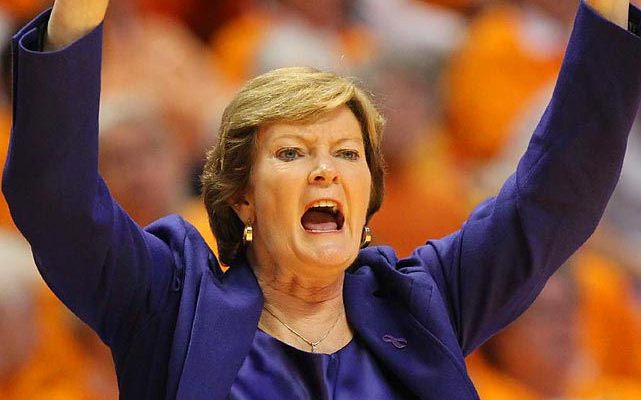

The story has been told that Pat Summitt was approached twice about becoming men’s basketball coach at the University of Tennessee, once in 1994 and again seven years later.
Summitt, who died early Tuesday from complications of early onset dementia, turned Tennessee officials down each time. It was the right answer each time.
Had Summitt, college basketball’s winningest all-time coach — regardless of gender — jumped to the men’s game, her success would have been used as some kind of crucible, a measure of proof, of sorts, that women could make it in the rough and tumble world of men’s athletics, playing by their rules.
But Summitt’s goal was never to establish her worth by comparing what she and her team accomplished relative to men. No, her idea was to prove that what women do on the court or on a playing field was worthy of attention just because women were doing it.
Even in her death, obituaries from well-meaning media outlets have turned to sources like former NFL quarterback Peyton Manning, who starred at Tennessee while Summitt was coach, to validate her achievements.
If you couldn’t recognize the greatness of one of sport’s pioneering figures without a man’s stamp of acceptance and approval, that’s a you-problem, not a Summitt problem.
As it was, Summitt’s Lady Vols captured eight NCAA championships and made 18 Final Four appearances in 38 seasons. Her teams advanced to the NCAA tournament 31 times and won the Southeastern Conference regular season 16 times as well as winning 16 SEC tournament titles.
Here’s what might the most remarkable number attached to Summitt: Her teams were ranked in the Associated Press poll for a record 618 weeks — nearly 100 more than Georgia’s Andy Landers.
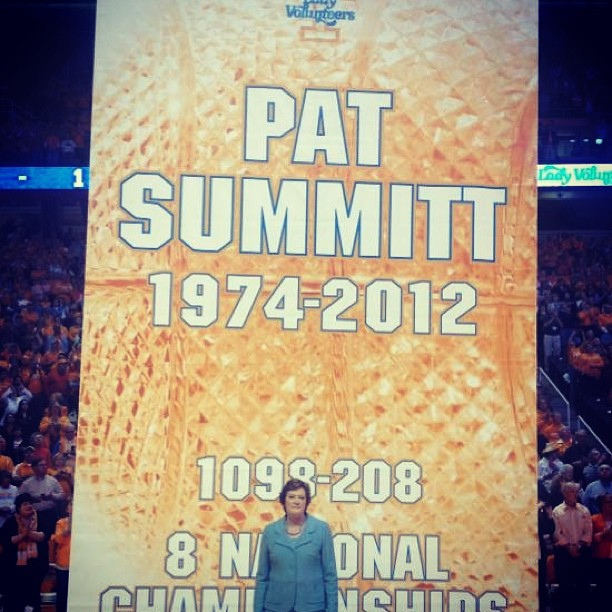
Patricia Sue Head Summitt, born to a Middle Tennessee farm family, would have been a dominant figure in any field of endeavor that she chose. The dint of her will dictated that. Everyone who ever came in contact with her had a tale about getting caught in the gaze of her piercing blue-eyed stare.
Here’s mine: Summitt brought the Lady Vols to Maryland for a game in the early 1990s. The game was in College Park, but the team spent the night before in Baltimore so that one of the Vol players, forward Dana Johnson, an area native, could enjoy being at home. The team had travel issues and didn’t get to the downtown seafood restaurant until late, but Summitt kept her word that she would talk to a Baltimore Sun reporter for an advance story.
And while Summitt was unfailingly gracious to me, I was always aware of her eyes boring in on me as I asked my questions. I worked fast so she could get back to her team.
And being with her team, her Lady Vols is, in a nutshell, is why Pat Summitt had to do what she did and where she did it.
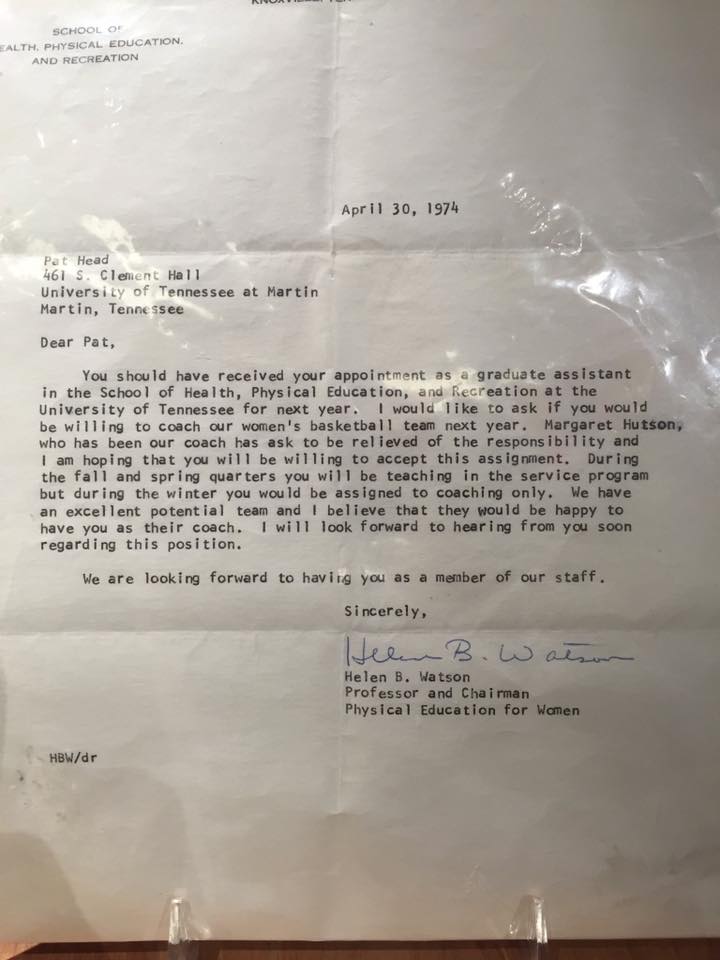
When Summitt, who had been a graduate assistant, was asked to take over as head basketball coach in 1974 in the letter below, the athletic landscape for women was nothing short of dreadful. Title IX had only recently been enacted and the idea that women could pursue sports as a career or way of life was laughable.
Back then, many schools didn’t offer athletic programs for women and those that did had to form their own governing board, the Association of Athletics for Women (AIAW). It wasn’t until 1982 that the NCAA even staged a women’s basketball national championship.
While there were a group of hardy pioneers like Texas’ Jody Conradt, Maryland’s Chris Weller, North Carolina State’s Kay Yow and C. Vivian Stringer, then of Cheyney State, later at Iowa and now Rutgers, Summitt emerged as the leader, though she didn’t win her first title until 1987.
Once the championships started rolling — six in 12 years — and the Lady Vols became, as former Tennessee men’s coach Bruce Pearl described them, “a brand,” there came consistent questions on whether she would leave women’s basketball for men’s hoops, the inference being that the move would be an improvement. Summitt’s ready retort was “Why is that considered a step up?”
Even now, 40-plus after Summitt signed on at Tennessee, women’s athletics continue to languish behind men’s sports in terms of attention, revenue and commitment from higher ups to promote and grow the game.
To compound the issue, women’s athletics still suffers from a double shot of backhanded treatment from sports media. Either reporters and editors totally ignore the contributions of female athletes or talk show hosts demean and humiliate them. Since Summitt’s death, it’s been amazing to listen to men who wouldn’t get caught dead within miles of a women’s basketball game falling prostrate to lionize her contributions.
Summitt stayed with women’s basketball and women’s sports because they needed her. Simply put, Summitt made it possible for women to believe that their athletic contributions mattered. Little girls and young women need to know that what they do on the playing field is just as significant as what little boys and young men do.
She loved us for who we were from first to the last person on the bench, black, white, gay, straight. Y’all get my point. She just expected excellence on and off the court.
Former Lady Vol player Chamique Holdsclaw from her Facebook page
Her presence not only meant that the cavernous Thompson-Boling Arena Tennessee plays in would be full for games, but that Gampel Pavilion in Storrs, Conn., Cole Field House in College Park, Md., San Jose Arena in San Jose, Calif. and even Cameron Indoor Stadium at Duke would have more than just family and close friends watching. Those young women and all the others who play a sport deserve sellout crowds and raucous fans as much as young men do.
And as we rush to turn Pat Summitt into an icon, we should never forget how much of a competitor and basketball genius she was. She was constantly on the move, cribbing and borrowing from other coaches in an attempt to be a better coach. Yes, she would legendarily play any opponent anywhere at any time, not just to grow the game, but to get a look at who she might have to face later.
My friend Christy Winters-Scott, a terrific basketball player turned commentator, told the story of how her Terps forced a tie with Tennessee with less than three minutes to go in a national semifinal game in the 1989 Final Four.
As Christy tells it, Summitt called timeout, gave the Lady Vols “the steely-eyed stare,” then switched them into a 1-3-1 trapping defense that took Maryland out of its rhythm. Tennessee went on to win that game and the national title, their second, two days later.
My favorite Summitt coaching moment came in the 1998 regional final game against North Carolina. The Lady Vols had already won two titles and were in a quest to run the table undefeated, behind three remarkable junior Chamique Holdsclaw, the reigning National Player of the Year, and a pair of freshmen, guard Semeka Randall and forward Tamika Catchings.
The game against the Tar Heels, played at Vanderbilt’s Memorial Gym, set up to essentially be a home game with an ocean of orange in the stands. However, North Carolina, perhaps the only team in the country that could match Tennessee’s athleticism, ran over and around the Lady Vols, or at least for the first 32 minutes.
Summitt took Tennessee out of its traditional man-to-man and put them in a trap similar to what they had employed against Maryland nine years before. Different game, same result: The Lady Vols erased a 17-point deficit over the last seven minutes to get to the Final Four, where they cruised to another title. That team, which went 39-0, remains in my mind the best I’ve ever seen at the women’s college level.
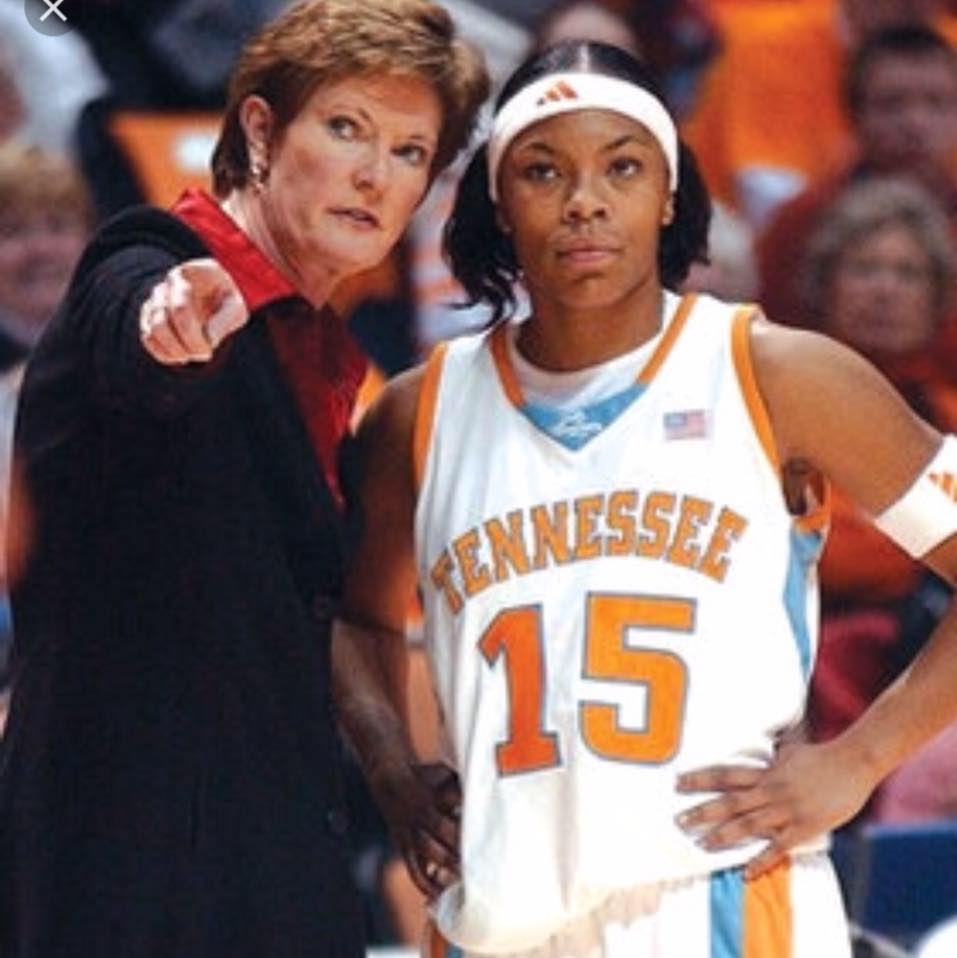
Beyond tactician and icon, the most important roles of a college coach are to educate and to mold minds. Those may sound like functions of a bygone era, but Summitt lived it. Her methods weren’t for everyone, and more than a few Lady Vols shipped out.
But the ones who stayed swear by her and many gathered by her side in those last painful days. They lead to the most important statistic attached to Pat Summitt and what will be, by far, her most important legacy far beyond wins and championships. Every one of her players that stayed for the full four years they were in Knoxville graduated and received a diploma.
That alone makes Pat Summitt the biggest winner ever.
 sports@large blog