The social media flood came over the last few days the way it always does when someone famous dies.
First, in trickles, then in a wave, people flock to Facebook or Twitter or, for millennials, Instagram or Snapchat, to share their remembrances of the dearly departed and what said celebrity meant to them.
In the case of Muhammad Ali, the flood quickly erupted into a tsunami. From expressions of sadness of the great boxer’s passing to recounts of personal meetings with the former champ, few relevant corners were missed.
That’s few, but not all. I, for one, would like to hear from the family of Joe Frazier, the fellow former champion whose three fights with Ali rank among the greatest in modern boxing history. I’d love to know if former heavyweight Marvis Frazier and his family feel as warm a glow towards Ali as the rest of the world given the way Ali portrayed their dad.
To be sure, Ali was part of stirring and important fights with Sonny Liston, whom he wrested the heavyweight title away from at age 22; with George Foreman in the seminal “Rumble in the Jungle,” and Ken Norton and Floyd Patterson, among others.
But his battles with Frazier were legendary, albeit tinged with vicious putdowns of the Philadelphia-based southpaw that strayed well beyond the clever turns of phrases that Ali employed against many of his opponents.
Indeed, Ali’s references to Frazier as a gorilla and as an Uncle Tom were well beyond the pale and certainly more than the normal pre-fight hype, even from the loquacious Ali.
Frazier and Ali should have formed the template for how once fierce rivals deal with their foes after playing days are done.
Instead, it was Magic Johnson and Larry Bird, who barely respected the other when they first competed in the 1979 NCAA championship game but eventually came to respect and revere each other through years of NBA championship competition, who showed how athletic adversaries could co-exist in later life.
Between 1971 and 1975, Frazier and Ali staged a remarkable series of contests, a trilogy so alternately savage and elegant that a writer last week called the competition outside of that of David vs. Goliath “the greatest rivalry in the history of individual human combat.”
Their first fight took place March 8, 1971 at Madison Square Garden, pitting an unbeaten Ali looking to regain the heavyweight title against an undefeated Frazier, the man who had been champion for just over a year at the time of the fight.
That March bout was such a cosmic event that Frank Sinatra and John Lennon, two figures from diametrically opposite sides of the cultural zeitgeist attended. And what they saw was magic.
Ali and Frazier battled through 14 grueling rounds, until Frazier clinched a unanimous decision by knocking Ali to the canvas in the 15th round. It marked the first time Ali had suffered as much as a knockdown to that point and set the scene for what was to come.
Ali won the rematch – also in the Garden — nearly three years later, but there was no title on the line, as Frazier had lost the crown to George Foreman in January, 1973.
Ali reclaimed the championship in August, 1974 in the “Rumble in the Jungle,” as he knocked out Foreman using the famed “rope-a-dope” strategy in Zaire.
Just over a year later, Frazier and Ali would fight one last magnificent time, with this battle coming in “The Thrilla in Manilla.”
The fighters, by now well into their 30s and theoretically out of their primes, staged a stirring final act in a savage fight, which continued through 14 of a scheduled 15 rounds.
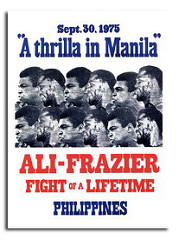
Frazier battled gamely through the last three rounds with his eyes nearly swollen shut, with the fight ending only when Frazier’s trainer, Eddie Futch, refused to let him come out for the 15th round.
Ali collapsed in the ring, saying later it was the closest he had ever come to dying.
Frazier and Ali weren’t exactly cut from the same cloth. While they were native southerners – Ali from Louisville and Frazier from South Carolina – and both won Olympic gold medals, Ali was taller and fought with a far more fluid style than Frazier, who was more a brawler with a lethal left hand.
Their fights came loaded with the sociological baggage of the era. Ali had been stripped of the heavyweight title in 1967 when he refused induction into the U.S. Army, claiming conscientious objector status and contending famously that he had no beef with the Viet Cong.
Ali was sentenced to five years imprisonment and while he never went to jail, he couldn’t get a license to fight domestically and was not allowed to leave the country to box as well. His conviction was eventually overturned by the Supreme Court in 1970.
In the interim, Frazier, among others, lobbied for Ali’s conviction to be overturned and for his reinstatement, even loaning him money.
Frazier’s largesse wasn’t entirely selfless. He knew that Ali’s notoriety could bring a big payday to the heavyweight division.
During his time out of the ring, Ali became an icon of conscience and an heroic symbol of anti-war and anti-government sentiment.
Frazier, meanwhile, was seen – through no fault of his own – as an establishment figure, his image suffering in direct comparison to the charismatic Ali.
Frazier didn’t think Ali would be grateful, but he surely didn’t expect Ali to unleash a barrage of insults in the time before and between the fights.
In the walk-up to the final fight, Ali publicly, loudly and repeatedly called Frazier a gorilla and an Uncle Tom, playing on the worst of racial stereotypes to reduce a noble competitor and former friend into a caricature.
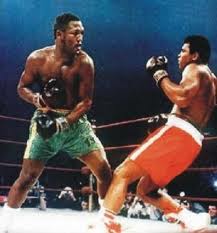
Possessing Ali’s punching power, but not his gift of gab, Frazier was unable to either return verbal fire or to understand why his former friend turned on him so cruelly.
Frazier became embittered, and it took more than 25 years before Ali apologized. However, the apology did not come in person, but rather through an Ali quote to the New York Times.
Frazier, who had earlier wished that Ali had fallen into the Olympic cauldron he lit in Atlanta before the 1996 Summer Games, forgave him, saying ”I’ll accept it (the apology), shake his hand and hug him when I see him. We’re grown guys. This has been going on too long. It’s like we’ve been fighting the Vietnam War. We’re two athletes of the world. Why we been biting off bullets? We have to embrace each other. It’s time to talk and get together. Life’s too short.”
Upon Frazier’s death five years ago, Ali said he would always respect and admire him. Maybe, since last Friday, he’s had a chance to tell Frazier personally.
 sports@large blog